
A Victorian cookbook, charmingly titled Little Dinners: How to Serve Them with Elegance and Economy (1877), by Mary Hooper, claims to show ‘How the best use can be made of cheap material, and helps to revive what threatens to become a lost art in the home.’ Indeed, 150 years ago there were grumblings about the dying art of economy and self-sufficiency. Writers were moaning about this in earlier times, and continue to do so today. History does tend to repeat itself.
Nevertheless, perhaps there is in fact a market for books that stress economy today, when we are more aware than we have been for many generations, on the importance of frugality, the need for sustainable choices, the value in wasting less to have more.
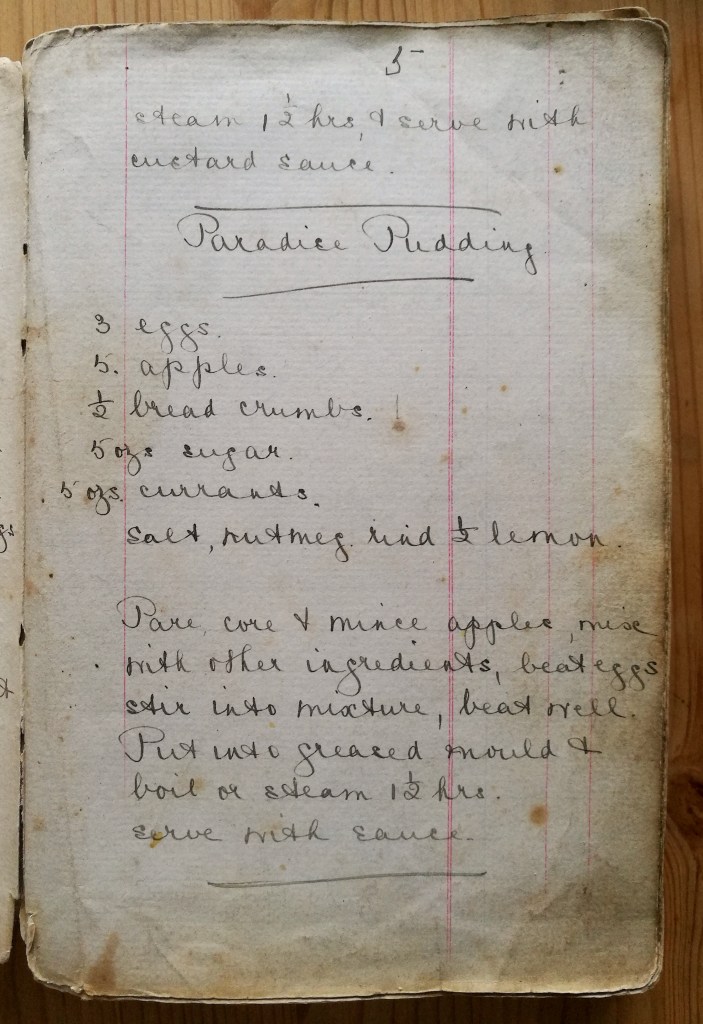
All this serves as a talking point for recipe #5 in The Cookbook. What happened to 3-4, I hear you cry? Good question. That page is missing. Perhaps the original writer made an error she didn’t want to preserve, or perhaps it fell out years ago and found its way to the bin rather than back into the collection. All we know of recipe #4, from the part of it that slipped onto page 5, is that it was another boiled pudding, served with custard. My kind of pudding.
Recipe #5 is for Paradise Pudding. I did some research to see if I could find other examples of this recipe, and to see how far back I could take its existence. This particular Paradise Pudding is not to be confused with a dessert of the same name originating in the 1920s that makes unholy combination of marshmallows, maraschino cherries, whipped cream and Jell-O. This Paradise Pudding has so much in common with Pudding a la Rachel (recipe 1) that I’m frankly surprised to see both in quick succession in the same family cookbook. Why would you want to have both? It’s so similar, in fact, that I include it here for the aim of completism of this project, but I have decided not to actually recreate it.
Paradise Pudding
3 eggs
5 apples
1/2(lb) bread crumbs
5oz sugar
5oz currants
salt, nutmeg and 1/2 lemon
Pare, core & mince apples, mix with other ingredients, beat eggs, stir into mixture, beat well. Put into greased mould & boil or steam 1/12 hrs. Serve with sauce.
The main difference with this pudding is that it does not use suet, but does include sugar. Perhaps the point of having both is to ensure you’ve got options, depending on the ingredients on hand in the larder? The Little Dinners version runs as follows: Six ounces of bread crumbs, six ounces of sugar, six ounces of currants, six apples grated, six ounces of butter beaten to a cream, six eggs, a little lemon peel chopped fine, and a small quantity of nutmeg. Boil in a shape three hours. Serve with wine sauce.
I do like ‘Boil in a shape.’ This version includes a hefty addition of butter to the pudding batter. Little Dinners however might have been a bit cheeky in sourcing this recipe. It appears almost identically in The Illustrated London Almanack for 1851:

Potentially the most widely referenced version of the recipe, one which, like the one in our Cookbook, contains no fats at all except a small amount of butter in the mould, occurs in Isabella Beeton’s The Book of Household Management where it has graced the puddings section since its first edition in 1861. The text of 1896 version:
Paradise Pudding Ingredients. — 3 eggs, 3 apples, ¼ lb. breadcrumbs, 3 oz. sugar, 3 oz. currants, salt and grated nutmeg to taste, the rind of ½ lemon, ½ wineglassful brandy.
Mode. — Pare, core, and mince the apples into small pieces, and mix them with the other dry ingredients; beat up the eggs, moisten the mixture with these, and beat well; stir in the brandy, and put the pudding into a buttered mold; tie it down with a cloth, boil for 1½ hour (sic), and serve with sweet sauce.

One source, pictured here, suggests that this recipe is even older, though no definitive date can be attached to the manuscript available online under the title An Anonymous Collection of Culinary and Medical Reciepts. Other than for its poetry, this last version of the recipe is valuable as well for its clear identification of where the name of this pudding originates – the fruit of the Tree of Knowledge in the Garden of Eden, or Paradise. “Take of the same fruit which Eve once did taste, Well pared + well clipped, half a dozen at least.” Towards the end of the text, in a moment of reader reassurance, “Adam tasted this Pudding twas wonderous.”
There are other versions of this recipe available for comparison, but you get the general idea. The ratio of ingredients varies slightly, with more apples or fewer, fats or no fats, more or less sugar, booze or no booze Here is another recipe for which you need only the most basic and widely-available ingredients, some lemon to tart it up and potentially a bit of booze in the pudding or in the sauce to give it a warming and digestive flair.
 Grounded History